Imagine opening a bag of coffee and finding beans that look almost twice the size of the ones you usually buy. They are not a different kind of nut or some unusual roasting mistake. They are real coffee beans, and they have a name: Elephant Beans.
These unusually large beans come from a type of Arabica coffee called Maragogipe (also spelled Maragogype). They are known for their oversized appearance, but their size is only part of what makes them interesting.
So why are these coffee beans so big? Do they taste different from regular coffee? And are they worth trying? Here is what you should know before looking for a bag.
What Is Elephant Bean Coffee?
Elephant Bean is a nickname for Maragogipe, a natural mutation of the Typica variety of Arabica coffee.
It was first discovered around 1870 in Maragogipe, a municipality in Bahia, Brazil. The variety became famous because almost everything about the plant is unusually large, including its leaves, cherries, and coffee seeds.
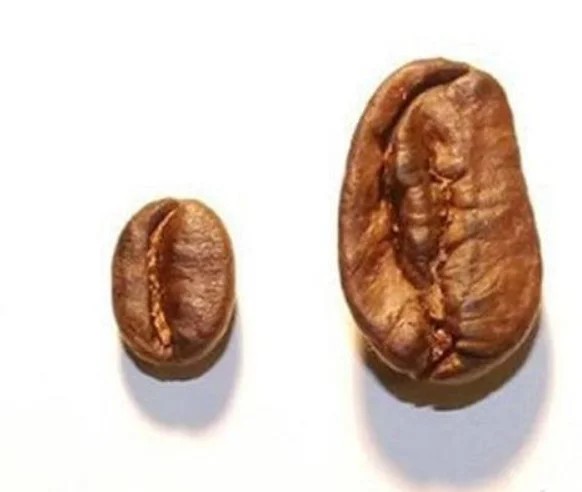
The name Elephant Bean makes sense when you see the beans next to ordinary Arabica coffee. They can look noticeably larger and more elongated.
You may also see this coffee listed under names such as Maragogipe coffee, Maragogype coffee, or Maragogipe Arabica. These names refer to the same variety.
It is still 100% Arabica coffee. The unusual size does not mean it belongs to a different coffee species.
Why Are Elephant Coffee Beans So Big?
The large size comes from the plant's natural genetic mutation, not from a special growing trick or extra fertilizer.
Maragogipe has a genetic characteristic that causes several parts of the plant to grow larger than those of typical Arabica varieties. This includes its leaves, the spaces between branches, coffee cherries, and seeds.
That is why the beans can look so different from the familiar coffee beans found in supermarkets.
There is another interesting detail: Maragogipe plants are not particularly easy for farmers to grow commercially.
They tend to produce fewer coffee cherries than many other varieties and are susceptible to problems such as coffee leaf rust. This makes large-scale production less attractive for some farms.
As a result, Maragogipe is not as commonly available as everyday varieties such as Caturra or Catuai.
Where Does Maragogipe Coffee Come From?
Maragogipe originated in Bahia, Brazil, but it is not limited to Brazil today.
The variety has also been grown in several Central and Latin American coffee-producing countries, including Guatemala, Mexico, Nicaragua, El Salvador, and Colombia.
Where it is grown matters because coffee flavor is influenced by more than the variety itself. Altitude, climate, soil, harvesting, processing, and roasting can all change the final cup.
This is why two bags of Maragogipe from different farms may not taste exactly alike.
If you see Maragogipe listed on a specialty coffee bag, check whether the seller also provides the country, growing region, farm, and processing method. Those details help you understand what you are actually buying.
For a better understanding of these labels, see our guide to what Single Origin coffee actually tells you.
What Does Maragogipe Coffee Taste Like?
You might expect such unusually large beans to have an equally unusual or powerful flavor. However, Maragogipe is often described as a relatively mild and delicate coffee.
Depending on where it is grown and how it is processed, you may find tasting notes such as:
- Floral aromas
- Gentle citrus acidity
- Mild sweetness
- Soft, balanced flavors
- A smooth overall impression
Some Maragogipe coffees have a lighter body and less intense flavor than people expect from their appearance.
However, there is no single flavor profile that applies to every bag. A coffee grown at a different altitude or processed using a different method can taste noticeably different.
Also, remember that tasting notes are descriptions of flavors and aromas, not ingredients added to the coffee. If you are unfamiliar with terms such as floral, citrus, or sweet acidity, our guide to what coffee tasting notes actually mean can help you understand them.
Are Bigger Coffee Beans Better?
Not necessarily. A larger coffee bean does not automatically mean better coffee.
Bean size is a physical characteristic of the variety. It does not tell you everything about how the coffee will taste or how carefully it was produced.
For example, a smaller Arabica bean from a well-managed farm can produce a much more enjoyable cup than a large bean that was poorly harvested, processed, or roasted.
Maragogipe is interesting because of its unusual size and its potential cup quality, not because bigger beans always mean higher quality.
If you are buying coffee, pay attention to the roast date, origin, processing method, and tasting notes rather than choosing a bag simply because the beans look impressive.
Maragogipe vs. Pacamara: Are They the Same?
You may also come across Pacamara when researching large coffee beans. The two varieties are related, but they are not the same.
Maragogipe is a natural mutation of Typica. Pacamara, on the other hand, was developed by crossing Pacas and Maragogipe.
Both varieties are known for producing very large beans, which explains why they are sometimes confused.
However, their plants and genetic backgrounds are different. Pacamara is also known for producing distinctive and sometimes complex flavor profiles.
So, if you see Pacamara on a coffee bag, do not assume it is simply another name for Elephant Bean. It is a separate coffee variety.
Is Elephant Bean Coffee Worth Trying?
If you enjoy exploring different Arabica varieties, Maragogipe is certainly worth trying at least once.
Its unusually large beans make it interesting to look at, while its generally mild and delicate flavor can offer a different experience from more familiar coffees.
It may be especially appealing if you enjoy trying single-origin coffees and comparing how different varieties taste.
Before buying, consider a few things:
- Check the variety name: Look for Maragogipe or Maragogype on the packaging.
- Check the origin: Find out which country or farm produced the beans.
- Read the tasting notes: Look for flavor descriptions that match your preferences.
- Check the roast date: Freshness still matters, even for unusual coffee varieties.
You may not find Elephant Bean in every coffee shop or supermarket, but specialty coffee roasters occasionally offer it as a limited or small-batch coffee.
And if you do come across a bag, the oversized beans are a good reason to take a closer look. Just remember that the real test is how they taste in your cup.